
Buyer's brief
What this guide helps you decide
- A matching set is one production plan, not two products. Fabric, dye lot and ship date must match.
- Two size systems need one pair matrix, or the set looks wrong on the shelf and in photos.
- The pouch is the part that fails. Test the load on the finished sample, not on the drawing.
- Sample one garment at a time. Approving both together hides which change fixed the fit.
01 — The idea
Why the two garments must be planned as one
An owner and pet set looks like two products. On the factory floor it is one plan. The fabric, the dye lot and the ship date all have to match.
If you buy the human piece from one supplier and the pet piece from another, the colours will not match. Close is worse than different, because the customer sees the difference at home in normal light.
One factory also means one person is responsible when the set arrives wrong. There is no argument between two vendors about which half caused it.
02 — Sizing
Two size systems on one specification sheet
The human piece runs on human sizes. The pet piece runs on chest girth, back length and neck opening. Those are two different languages on one sheet.
Build a pair matrix before you order anything. It answers one question for each line: which pet size sits beside which human size, both on the shelf and in the photo.
The matrix is a marketing decision as much as a production one. A medium human with an extra small dog is a different picture from a large human with a large dog.
03 — Colour
One fabric roll, one dye lot
A set is judged on colour match. This is the easiest thing to get wrong and the cheapest thing to control.
- →Order the total metres for both garments in one dye lot.
- →Ask for the lot number in writing, and keep it for the reorder.
- →Hold spare fabric from the same lot for replacements and samples.
- →Check the match in daylight and in shop light, not on a screen.
04 — The hard part
The pouch is the part that fails
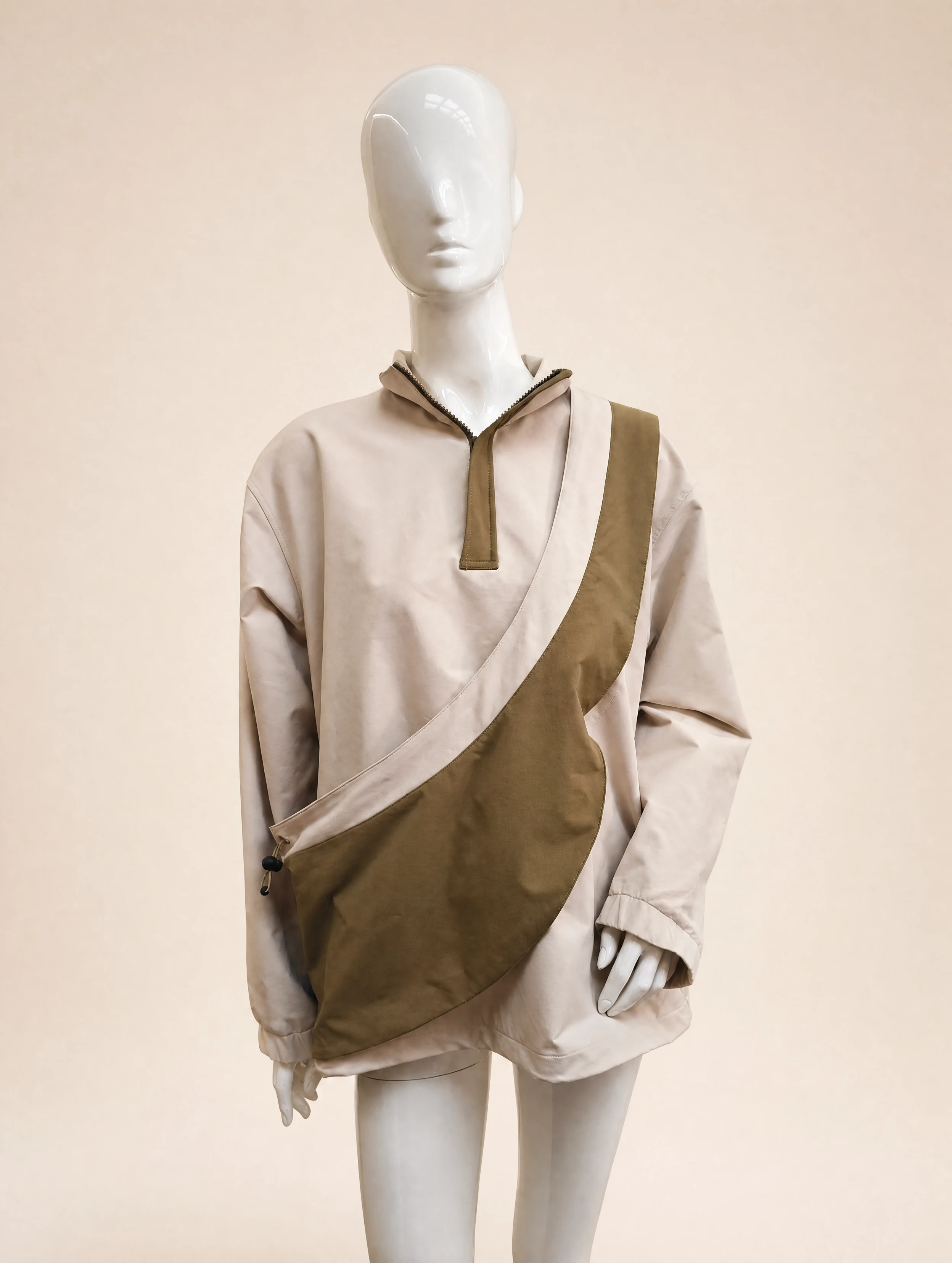
The carrier hoodie is a half-zip pullover in 380–420GSM French terry with a cross-body pouch, a safety toggle and a washable inner pad. The pullover is normal cut and sew work. The pouch is the engineering.
We build the pouch in two load tiers: up to 4 kg, and 4 to 8 kg. The load sits on a few seams, so the anchor points decide the rating. Change the anchor and you change the rating, even when the pouch looks the same.
Test the finished sample, not the drawing. Put the rated weight in the pouch, lift the pullover by one shoulder, walk fifty steps and turn. Then check the seams, the stitch line and the fabric around each anchor.
05 — Process
The sampling order that avoids rework
Sample in steps. Two garments approved at once hides the cause of a problem.
- →First, the human pullover in the agreed fabric. Check fit, neck entry and hem length on a real body.
- →Second, the pouch, built into that pullover. Check anchor position and where the weight sits on the hip.
- →Third, the load test at the tier you plan to sell.
- →Fourth, the pet garment, cut from the same lot. Check chest girth and shoulder clearance.
- →Fifth, wear both together for a full walk before you approve decoration.
06 — Order size
MOQ and cost for a set
Our minimum run is 30 pieces per colour and design. A pair counts as one design, so the minimum is met by 30 sets rather than 60 separate items.
That matters for pricing. The set is one setup, one cutting plan and one dye lot, so the setup cost spreads across the set instead of across two orders.
If you want to test two colourways, that is two runs. Most first orders start with one colourway and add the second after the launch.
07 — Price
A set has two prices, not one
You need two numbers before you brief a factory: the price of the set, and the price of each half on its own. Buyers ask for both, and the second number tells you whether the set is really a set.
Selling only as a set protects the colour match. Selling the halves separately grows the market, but you have to hold replacement stock in two size systems.
Keep the pouch tier in the product name. A 4 kg tier and a 4 to 8 kg tier are different products to a customer with a larger dog, even when the photo looks the same.
- →Cost the set as one setup, then compare it with two separate orders.
- →Decide the packaging: one box for the set, or two boxes that can be split.
- →Write the returns rule for each half before launch, not after the first complaint.
- →Shoot one photo of the set and one photo of each half. The single photos sell the replacement.
08 — Brief
Decide these seven things before you brief a factory
Each item changes the price or the pattern. Settle them in the first email, not the fifth.
- →The human size range and the pet size range, as two separate lists.
- →The pouch load tier you plan to sell.
- →Whether the set ships as one box or two.
- →Who wears it in the launch photos, and with which dog.
- →The retail price of the set, and the price of each half on its own.
- →What happens if a customer needs to replace only the pet piece.
- →The reorder plan, and how long the dye lot can be held.
{t.continueSourcing}
{t.related}
{t.faqEyebrow}
{t.faqTitle}
Can I order just the pet half of a matching set?
Yes. The pet garment is a normal pet apparel item and can be ordered on its own. The minimum still applies per colour and design.
How much weight can the pouch hold?
We build two tiers: up to 4 kg, and 4 to 8 kg. The rating is confirmed on the sealed sample after a load test, because the anchor stitching sets the limit.
Do both garments have to be the same fabric?
For a true set, yes, or the colour and the hand feel will not match. A different fabric is a different product and should be sold that way.