Breed-specific block · Dachshund

Custom Dachshund Clothes Manufacturer

MOQ 30 pcs3–5 days sampling20 days bulk lead timeDachshund block on request

We cut private-label dachshund clothes on a long-backed pattern block: chest depth placed at the deepest rib, back length carried to the tail root, and leg openings set for short legs. Sweaters and jumpers, coats and raincoats, four-leg fleece pyjamas and seasonal sets all run on the same size curve. Every programme starts from a physical sample you approve before bulk cutting.

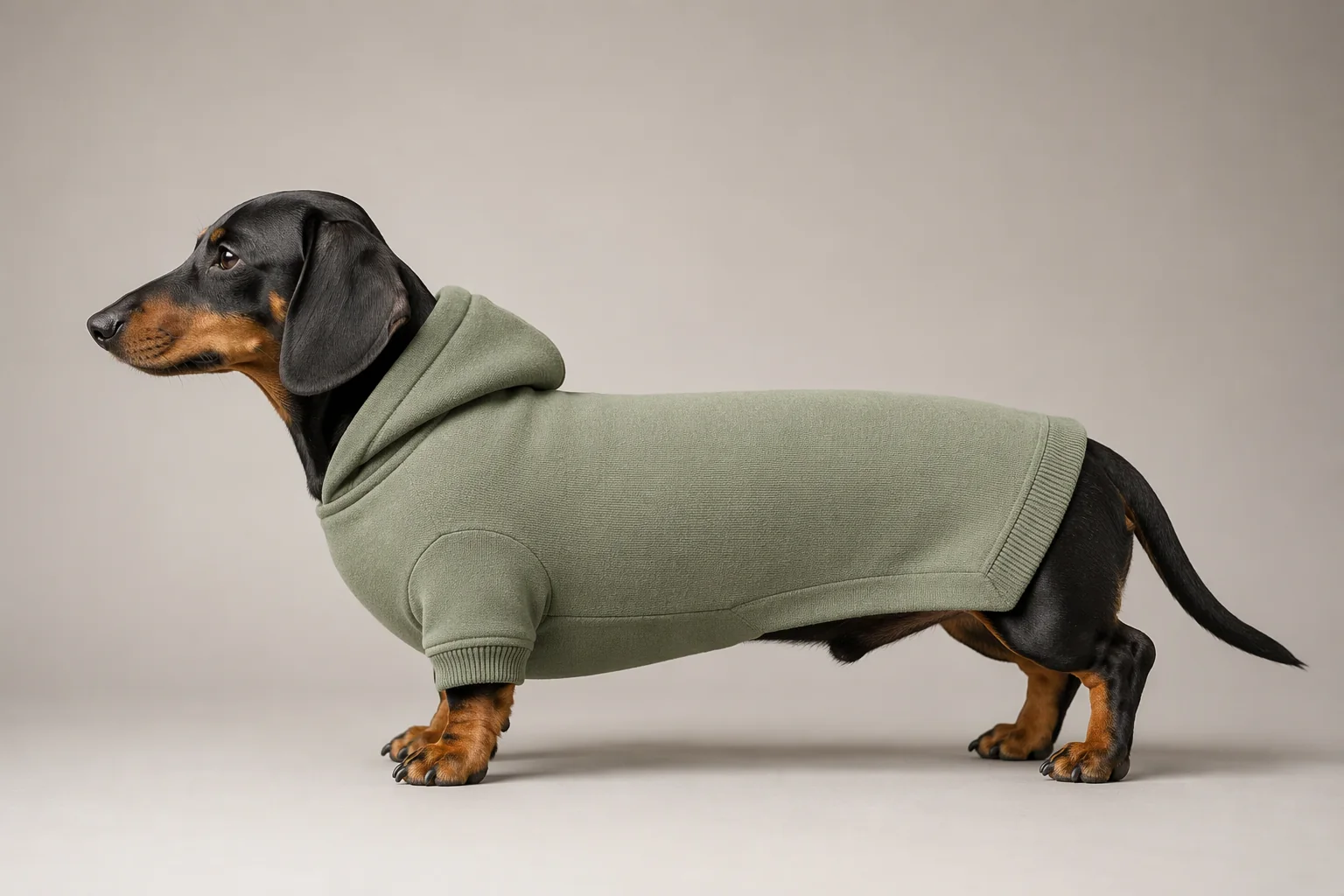
Dachshund wearing a custom hoodie cut on a long-backed breed block, with the hem finishing at the tail root
Studio reference — long-backed block: back panel carried to the tail root, hem clear of the ground, rib cuff above the paw.

Pattern engineering

A dachshund is not a scaled-down Labrador

The three places a standard dog block fails on this breed are the back panel, the chest depth and the hem. Each one is fixed on the pattern, not by ordering the next size up. For the underlying method, see how dog hoodie blocks are graded.

01

Back length is set by the breed, not the size label

A dachshund carries a long back on short legs. Cut that body on a square block and the back panel finishes short, so the topline rides up over the croup and the hem sits above the tail root instead of covering it.

02

Chest depth is measured at the deepest rib

The chest is deep and comparatively narrow, and it sits low. If the leg opening is placed from a deeper-chested block, the front panel pulls forward and binds at the shoulder instead of sitting flat over the sternum.

03

Ground clearance decides hem and cuff length

With short legs, a hem that looks correct on a taller dog drags on a wet pavement. Hem length and leg-cuff placement are set together, so the garment clears the ground on a walk without leaving the lower back exposed.

Range planning

Five builds on one dachshund block

Dachshund apparel demand lands in four places — sweaters and jumpers, coats and raincoats, four-leg fleece pyjamas, and seasonal decorated sets. Behind them sit five builds sharing one size curve, so a hoodie and a raincoat from the same programme fit the same dog.

Dachshund wearing a sage-green custom hoodie cut on a long-backed breed block

Hoodie

01

The knit layer shows a grading error first: back panel two centimetres short and the hem climbs over the croup. The two-panel hood and leash-slot pocket have to sit flat along a long spine.

Built as: Two-panel hood, kangaroo or leash-slot pocket, ribbed hem with elastic recovery, double-needle shoulder seams.

400GSM French TerryBrushed Anti-Pill Fleece · 280–320 GSMRecycled Cotton Blend · 260–300 GSM
View hoodie specification →
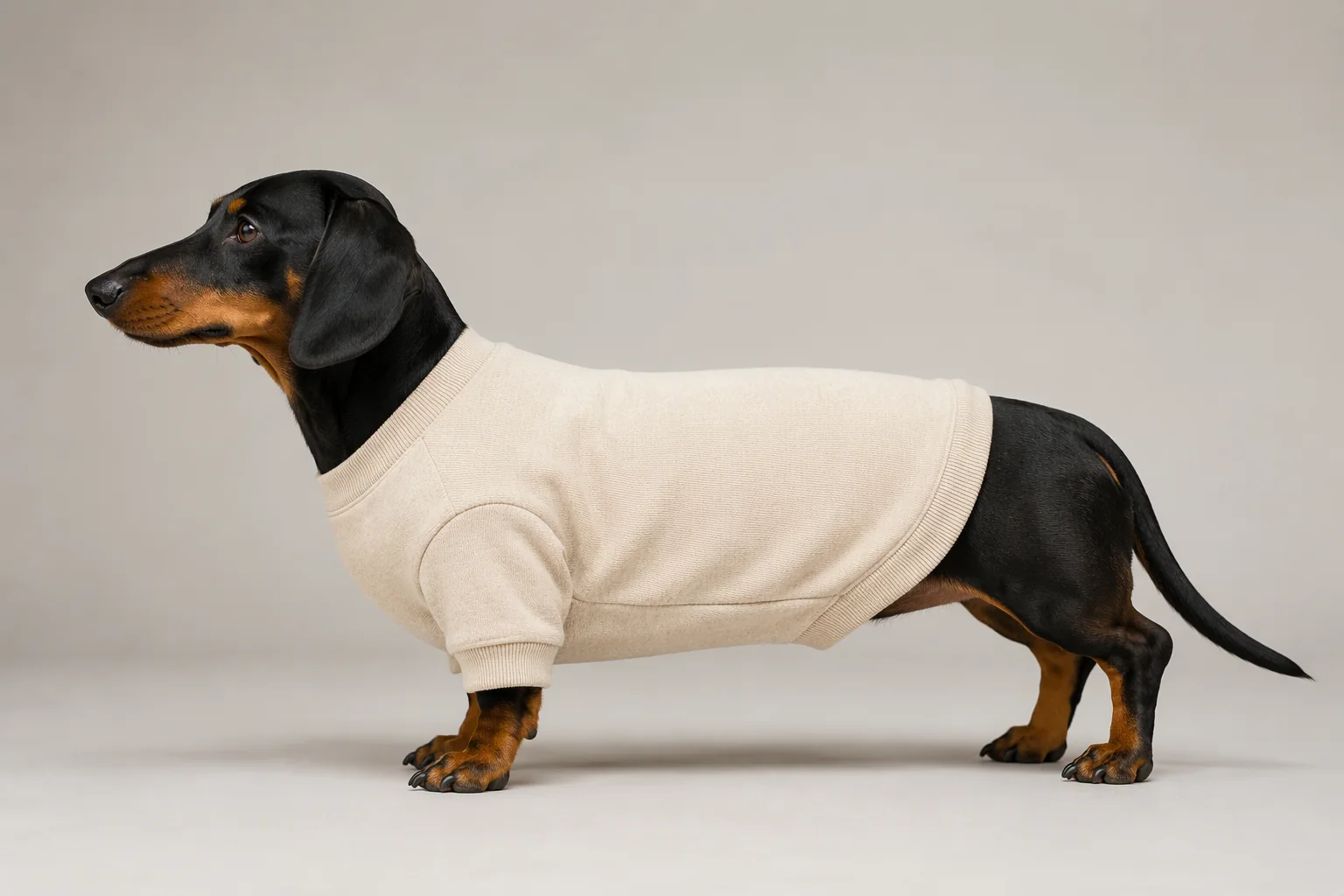
Dachshund wearing a cream 400GSM French terry sweatshirt with ribbed cuffs and hem

Sweatshirt

02

Same block, set-in sleeves. The shoulder seam has to land behind the short front legs, otherwise the sleeve climbs the neck when the dog walks instead of staying over the paw.

Built as: Set-in sleeves, ribbed cuffs and hem, single-needle neckline with a taped back neck.

400GSM French TerryBrushed Anti-Pill Fleece · 280–320 GSMRecycled Cotton Blend · 260–300 GSM
View sweatshirt specification →
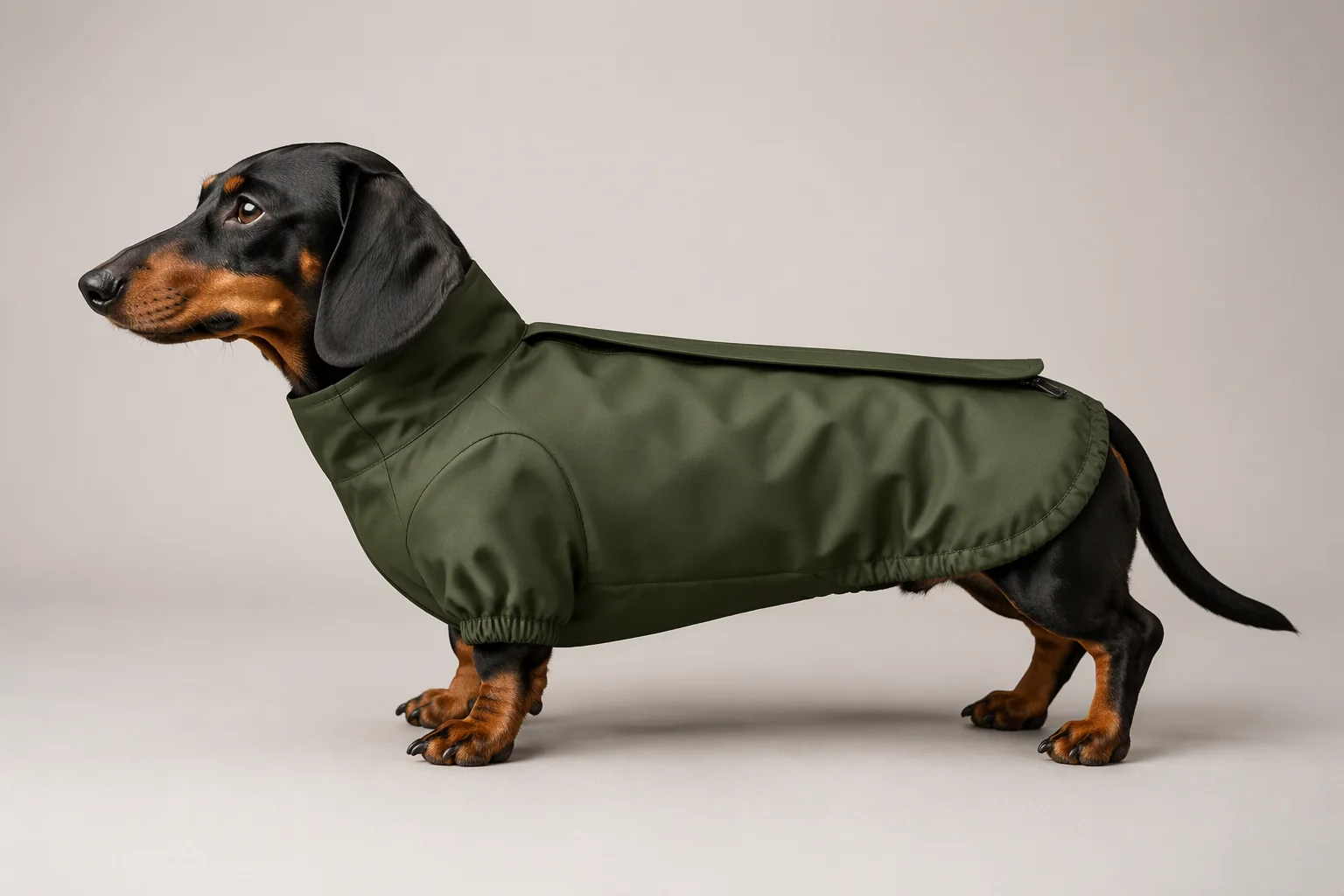
Dachshund wearing an olive waterproof softshell raincoat with a storm flap and elasticated cuffs

Raincoat

03

The outer layer is where the block pays for itself. Graded on a square dog it hangs off the back and leaves the tail root exposed, and a hem cut for a taller dog drags on wet pavement.

Built as: Taped or critically seam-sealed seams, storm flap over the zip, elasticated leg cuffs, optional harness opening.

Waterproof Softshell · 300–320 GSM
View raincoat specification →
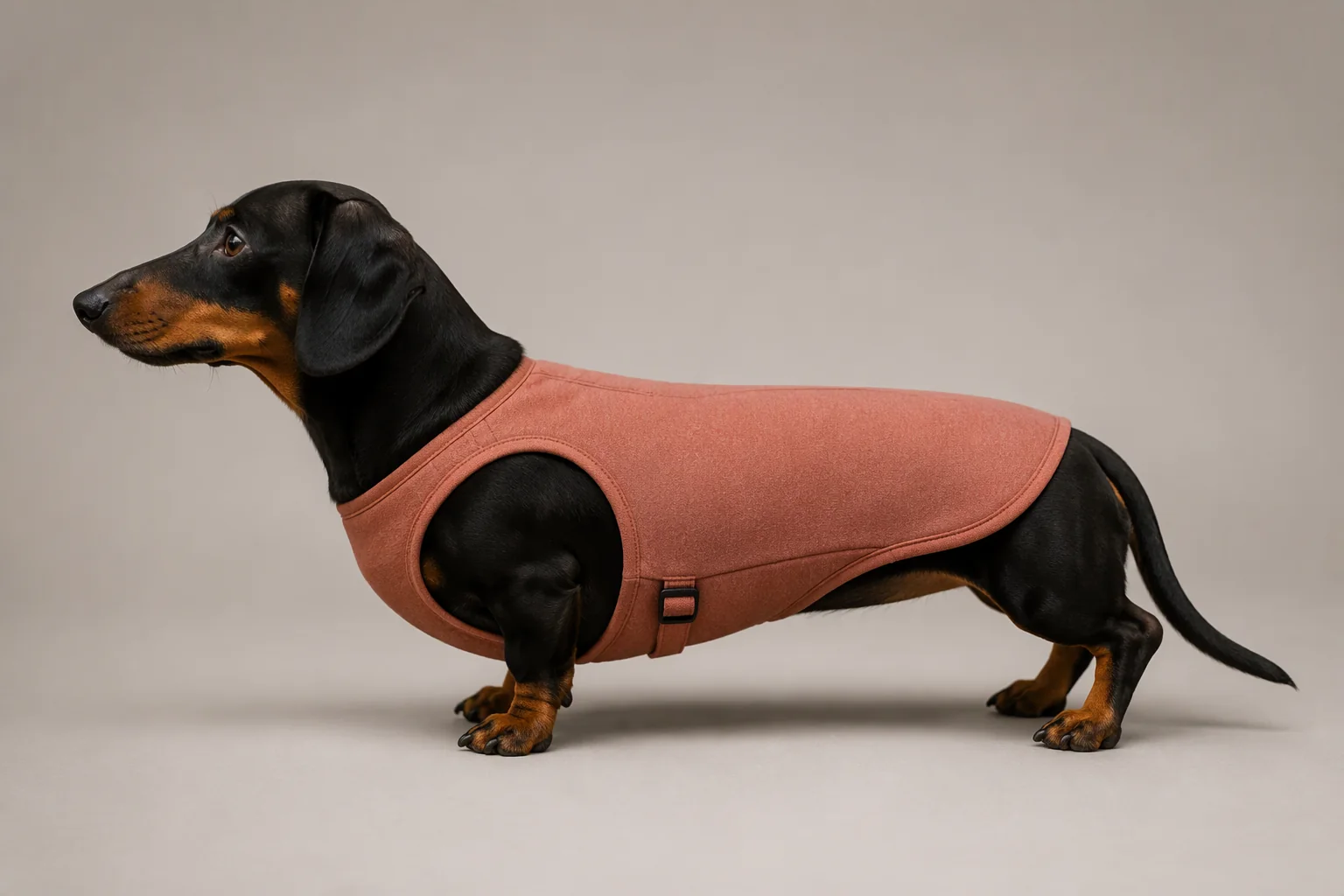
Dachshund wearing a terracotta recycled cotton blend vest with bound armholes and a side closure

Vest

04

Bound armholes and the adjustable side closure take up the girth difference between a mini and a standard. This is also the build seasonal decoration runs on, so artwork is agreed before cutting.

Built as: Bound armholes, adjustable side closure for girth tolerance, flat-felled seams on stress points.

Brushed Anti-Pill Fleece · 280–320 GSMWaterproof Softshell · 300–320 GSMRecycled Cotton Blend · 260–300 GSM+ embroidery / print / DTG
View vest specification →
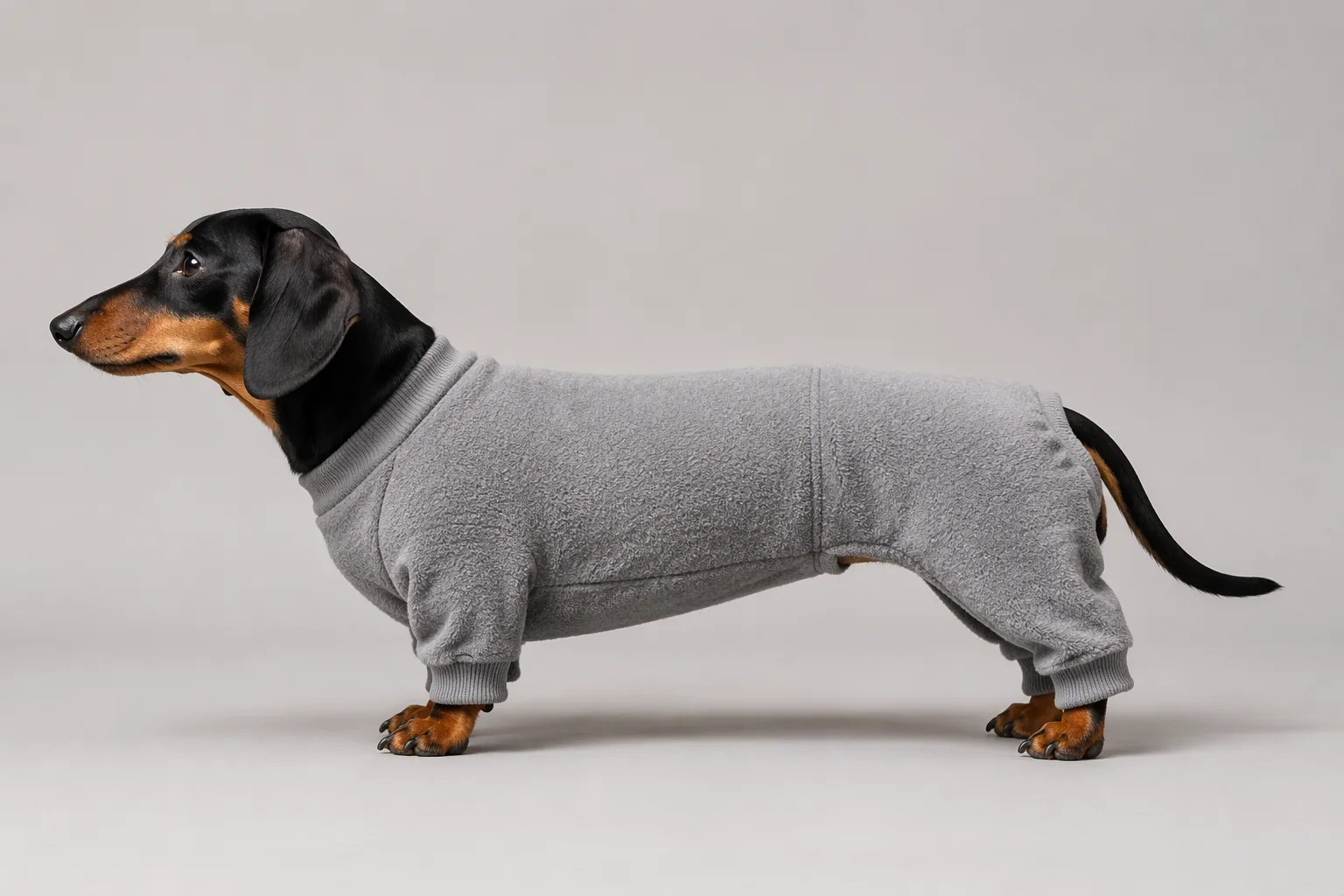
Dachshund wearing grey brushed fleece four-leg pyjamas with ribbed leg cuffs

Four-leg pyjamas

05

The most pattern pieces per size in the range. Four legs means four openings that all have to clear the ground and the body length at once, so a grading error shows on the first sample.

Built as: Four-leg block for full coverage, relaxed body, soft covered elastic waistband.

400GSM French TerryBrushed Anti-Pill Fleece · 280–320 GSMRecycled Cotton Blend · 260–300 GSM
View pyjama specification →

Fabric weights are the specification bands we buy against. Garment measurements are confirmed on the approved sample, and the reference size chart is not a factory specification.

Lock these four before you sample

On a long-backed body, a late change to one of these four re-cuts the whole pattern instead of adjusting a seam.

Pre-production pet garment sample checked on the sampling table
Sampling table — the block is checked on a sewn sample before bulk panels are cut.
  1. 1

    The block

    Confirm whether the programme runs on the dachshund block or on your own graded chart. Switching blocks after sampling restarts the fit approval, so this is decided before a sample is cut.

  2. 2

    Measurement points

    Chest girth, back length and neck opening are the three points the pattern is built around. Add the leg opening and the hem drop if your chart carries them, and state where each is measured.

  3. 3

    Openings and closures

    Harness or leash access, leg-cuff finish, and side or back closure all change the pattern. On a long-backed body they also change how the garment behaves when the dog walks, sits and lies down.

  4. 4

    Colour and decoration

    Approve a lab dip and the decoration position on the sewn sample rather than on a flat drawing. Placement tolerance is easier to agree before the bulk panels are cut.

Measure the dog, then pick the block

Graded on chest girth, back length and neck opening. Those three points decide whether a dachshund sits on the standard dog curve or on the breed block — a dog at the top of one size by weight can still need the block for back length.

Chest girth is taken around the deepest part of the ribcage, just behind the front legs. Back length runs from the base of the neck to the tail root — on this breed that is the measurement that decides the size, not weight. Neck opening is measured where the collar would sit.

  • Graded on chest girth, back length and neck opening
  • Sized XS–3XL plus breed-specific blocks (Dachshund, Frenchie, Labrador)
  • Leg openings positioned so the garment clears the shoulder without binding

Miniature or standard: two curves, not one

A miniature and a standard dachshund are not the same garment at different sizes. Girth and back length do not shrink together, so a range that covers both needs the curve stated in the brief before the block is graded — otherwise the middle sizes fit neither.

Reference chart or breed block?

Our published chart is a reference curve, not a factory specification. For a dachshund programme the size authority is the approved pre-production sample, graded either from your existing chart or from the breed block.

See how the measurement points are taken →

Dachshund sourcing questions

Do you hold a dachshund pattern, or do we have to develop one?
Dachshund is one of the breed-specific blocks we already grade for, alongside Frenchie and Labrador. We confirm the block against your measurement points and target size range before sampling, so development starts from a dachshund body rather than a scaled-up small-dog size.
What is the minimum order for a dachshund programme?
30 pcs per colour and design. A size run inside that quantity is fine — the minimum applies per colour and per design, not per size.
How long does sampling and bulk take?
A physical pre-production sample takes 3–5 days. Standard bulk production takes 20 days after the sample and the specification are approved.
Can you match the size chart our brand already uses?
Yes. Send the chart with the measurement points written out. The approved pre-production sample is the size authority before bulk fabric is cut, whether the curve comes from your chart or from our breed block.
Can one range cover miniature and standard dachshunds?
It can, but only if the curve is defined first. Girth and back length do not scale together between the two, so we grade the block to cover both ends and confirm the middle sizes on the sample.
Do you make four-leg fleece suits as well as coats?
Yes. Four-leg pyjamas and fleece suits run on the same breed block, with four leg openings that have to clear the ground and the body length at the same time. Coats and raincoats are a separate outer-layer build in waterproof softshell.

Request a dachshund programme quote

Send the garment, target quantity, size range and your measurement points. Sampling takes 3–5 days and standard bulk production takes 20 days after approval.

Tell us what you want to make

Takes about 30 seconds. Fields marked * are required.

Design file (optional)
JPG, PNG, PDF, Word or JPEG · max 3 MB

We use your details only to answer this enquiry. No newsletters.